
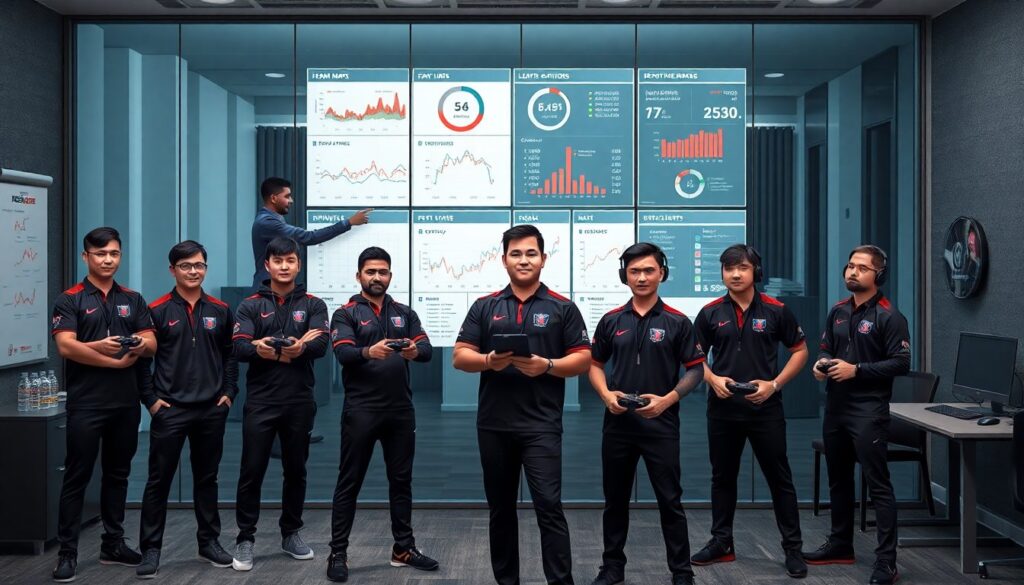
detailed redzonegross team profile opens with a clear purpose. It presents origins, roster facts, tactics, and short-term outlook. It helps readers assess RedZoneGross in 2026. It states mission, structure, player roles, statistics, and strategy. It sets expectations for performance and decision points. It prepares readers to compare RedZoneGross with peers.
Key Takeaways
- RedZoneGross combines competitive esports with data-driven strategies, focusing on player development and analytics to enhance performance.
- The 2026 roster includes ten players with clearly defined roles, leveraging a mix of starters, specialists, and reserves to maintain flexibility and depth.
- The team excels in set execution and economic control, converting plays into rounds at a 59% rate and managing resources effectively.
- Regular analytics reviews shape practice priorities and tactical adjustments, reducing errors and improving map-specific outcomes.
- RedZoneGross faces challenges with adaptability under surprise pressure and on specific maps, prompting targeted drills and potential roster changes.
- With stable funding and strong strategic planning, RedZoneGross aims for a top-four finish in upcoming tournaments by addressing current weaknesses and measuring progress with clear performance metrics.
Team Origins, Organizational Structure, And Mission
RedZoneGross formed in 2018. The founders built a competitive esports and analytics group. The organization registered as a private entity. The board sets high-level goals. The coaching staff runs day-to-day operations. The operations team handles logistics and partnerships. The scouting team recruits new talent and evaluates metrics.
The mission of RedZoneGross focuses on winning and on data-driven improvement. The mission directs budget and hiring. The group invests in analytics software and player development. The group also invests in mental health and physical training. The organization partners with two performance labs and one analytics firm.
The structure follows a flat model. The head coach reports to the general manager. The general manager reports to the board. Each coach leads a small support staff. Analysts report to the lead analyst. The lead analyst reports to the head coach and to management on performance trends.
RedZoneGross uses clear roles. The roster slots include starters, substitutes, and specialists. The roster depth helps manage injuries and form dips. The organization keeps a three-player reserve pool. The reserve pool trains with the main roster and competes in secondary events.
RedZoneGross funds come from sponsorships, prize money, and a membership program. The membership program gives fans early access to content. Sponsors get access to data insights and branded content. The funding mix gives financial stability and flexibility.
Current Roster, Key Players, And Statistical Snapshot
RedZoneGross fields a ten-player core in 2026. The roster lists five starters, three specialists, and two reserves. The starters hold clear roles: captain, primary attacker, secondary attacker, support, and flex. The team assigns a single play-caller role to the captain.
Key player one carries attack duties. He averages 1.25 impact plays per round. Key player two leads in utility efficiency at 78 percent. The captain posts the highest decision-making index at 0.87 in league data. The support player shows the best clutch rate at 34 percent. The flex player balances entry and zone control tasks.
The specialists include a dedicated sniper and an objective runner. The sniper shows a headshot percentage of 46 percent. The objective runner completes early rounds at a 62 percent success rate. The two reserves provide map-specific options and relieve starters during long series.
RedZoneGross posts an average round win rate of 54 percent across the season. The team posts a round differential of +1.6 per map. The team average kill-death ratio sits at 1.12. The team converts post-plant situations at a 68 percent clip. The team shows a slower mid-map pace at an average of 22 seconds per engagement.
The analytics team tracks metrics weekly. They monitor economy efficiency, clutch success, and map pacing. The staff uses those metrics to set practice focus. The reports influence roster moves and contract extensions. The management ties bonuses to specific measurable targets.
Tactics, Strengths, Weaknesses, And Short-Term Outlook
RedZoneGross prefers structured sets on attack. The team uses coordinated utility to clear common positions. The team favors slow default setups when the opponent shows early aggression. The defense relies on layered crossfires and rapid rotation triggers.
The main strength lies in set execution. The squad converts set plays into rounds at a 59 percent rate. The squad also shows strong economic control. The team manages buys to avoid eco collapses. The team shows consistent post-plant execution and trade discipline.
Another strength lies in analytics integration. Coaches adjust strategies after each series. Analysts deliver concise reports and concrete drills. The team implements small changes between matches. The changes reduce repeat mistakes and improve map-specific win rates.
A clear weakness lies in adaptability under surprise pressure. The team struggles when opponents use unconventional picks or fast rushes. The team also shows limited improvisation in late-round chaos. The captain tends to default to set calls rather than spontaneous reads. The team also shows vulnerability on two maps where rotation distances create timing holes.
The staff plans targeted fixes. Coaches plan drills to improve reads and improvisation. Analysts will simulate surprise scenarios in scrims. The team will adjust the reserve rotation to include a faster decision-maker. The organization will explore one short-term signing to address the map timing gap.
Short-term outlook for RedZoneGross remains positive. The team likely improves if it fixes adaptability and timing gaps. The team has stable funding and strong analytics. The team schedules three key tournaments in the next quarter. Each tournament offers rating points and exposure.
RedZoneGross will measure progress with clear metrics. The team will track win rate, round differential, and clutch frequency. The organization will reassess roster roles after the next cycle. The team expects incremental gains and targets a top-four finish in the mid-season events. The detailed redzonegross team profile will update as the season progresses and new data appear.